


The Catholicate
MeaningWhat is the Catholicate?
The word "Catholicos" means "the general head" or "general bishop" — equivalent to "universal Bishop." This title and rank are considerably more ancient than the title Patriarch in the history of the Christian Church.
In the early Church there were only three ranks: Episcopos (Bishop), Priest, and Deacon. By the end of the third century, certain bishops of major provincial capitals gained pre-eminence over neighbouring bishops and came to be known as Metropolitans — a reality recognised by the Ecumenical Councils of the fourth century.
By the fifth century, bishops of the great cities — Rome, Constantinople, Alexandria, and Antioch — gained oversight of surrounding churches and became Patriarchs. The equivalent rank in churches outside the Roman Empire was called Catholicos. Three ancient Catholicates existed before the fifth century: the Catholicate of the East (Persia), the Catholicate of Armenia, and the Catholicate of Georgia.
No rank or title is the monopoly of any single church. Any apostolic and national church holds the authority to designate its supreme head as Catholicos, Pope, or Patriarch — an authority the Malankara Orthodox Syrian Church exercised in 1912.
Apostolic RootsIndia's Apostolic Authority
Even though the formal title "Catholicos" had not existed in India before the twentieth century, the idea behind the Catholicate — a national, independent Church led by its own supreme head — was present from the earliest centuries of Indian Christianity.
Just as St. Peter is regarded as the first Pope of Rome, so St. Thomas is understood as the first Head — the first Catholicos — of the Church in India. The Apostle established the Church on the Malabar coast and put in place a structure for its continuing administration. That apostolic authority persisted through the succeeding centuries in an unbroken line.
"The Vatican Syriac codex 22, written in 1301 at Kodungalloor, refers to the Metropolitan of the Church as 'The Metropolitan Bishop of the See of St. Thomas, and the whole church of Christians in India.'"
The Church has always asserted that St. Thomas had his apostolic throne in India just as St. Peter had it in Rome or Antioch. When the Catholicate was formally established in 1912, the Catholicos assumed the title "Successor of the Apostolic Throne of St. Thomas."
HistoryEvolution of Authority in the Malankara Church
The Catholicate of the East did not arise suddenly. It is the culmination of nearly two millennia of gradual development of ecclesiastical authority within the Indian Church.
Apostolic Foundation
St. Thomas the Apostle arrives in India and founds the Church on the Malabar coast. He establishes the first ecclesiastical structure, appointing prelates — traditionally drawn from ancient families such as Pakalomattom, Sankarapuri, Kalli, and Kaliankal. The Pakalomattom family gradually gains prominence as the principal priestly lineage.
The Archdeacon Era
From the mid-fourth century, authority is vested in the Archdeacon — the unquestioned social, political, and spiritual leader of the Thomas Christians, holding the title Jathikku Karthavyan ("the lord of the community"). The Archdeacon commanded local soldiers for protection and functioned as the unchallenged supreme head.
When the Portuguese arrived in the sixteenth century they sought to bring the community under Roman Catholic control. The Synod of Udayamperur (1599) temporarily succeeded, but the community's resistance culminated in the Coonan Cross Oath of 1653 — a public act of defiance by which the Thomas Christians rejected Latin ecclesiastical authority.
Episcopal Elevation — Mar Thoma I
Following the Coonan Cross Oath, the community elevated the Archdeacon to the rank of bishop with the name Mar Thoma I. All the powers of the centuries-old Archdeacon, along with additional spiritual authority, were transferred to this newly consecrated bishop. The Mar Thoma Metrans — Mar Thoma I through Mar Thoma VIII — governed the Church from 1653 to 1816.
Malankara Metropolitan
Pulikottil Joseph Mar Dionysius became bishop in 1816 and received a Royal Proclamation from the Travancore government, formally recognising him as the Metropolitan of the community. The head of the Church henceforth bore the title Malankara Metropolitan. Dionysius II through V, Mar Athanasios, and others exercised enormous spiritual and temporal powers throughout the nineteenth century.
Patriarchal Interference and the Path to Autonomy
The Church invited Patriarch Peter III of Antioch to India in 1875 to help resolve internal tensions. Instead, the Patriarch asserted his own authority — presiding over the Synod of Mulanthuruthy (1876), dividing the Church into seven dioceses, and consecrating new bishops in a bid to subordinate the Malankara Metropolitan.
The Travancore Royal Court judgment of 1889 declared that the Patriarch held spiritual supervisory powers but no temporal authority. Unsatisfied, the Patriarch pressed for complete submission. When Mar Dionysius VI refused to sign a deed of complete allegiance, the Patriarch excommunicated him on 31 May 1911 — an act that made the Patriarch's intentions unmistakably clear.
The Consecration of the First Catholicos
With two rival Patriarchs in Antioch, the Malankara Church contacted Patriarch Abdedmassiah — the senior Patriarch, then in Turkey — and invited him to India. The Episcopal Synod unanimously proposed Mar Ivanios, Metropolitan of the Kandanadu Diocese, as the first Catholicos.
On 15 September 1912, at St. Mary's Church, Niranam — founded by St. Thomas himself — Mar Ivanios was consecrated as Mar Baselios Paulose I, the first Catholicos of the Malankara Church. Two Kalpanas (patriarchal letters) were issued declaring the importance, privileges, and functions of the new office.
"By the consecration of the Catholicos, the Indian Church asserted and declared its full autonomy and became a full autocephalous Church — a Church with its own Head."
Merging Spiritual and Temporal Authority
Through the Malankara Association in 1934, all the powers previously held by the Malankara Metropolitan were entrusted to the Catholicos. From that year, both spiritual and temporal authority were vested in a single person: the Catholicos and Malankara Metropolitan. The development of governance in the Indian Church reached its completed form.
Supreme Court Verdict and Reconciliation
The Patriarchal faction had long challenged the validity of the Catholicate in court. On 12 September 1958, the Constitutional Bench of the Supreme Court of India resolved the matter definitively:
"The Patriarch of Antioch has no authority over the Malankara Church and the Indian Church is completely free under the Catholicos of the East. All the parishes and properties of the Malankara Church are under the authority of the Catholicos." — Constitutional Bench of the Supreme Court of India, 1958
In December 1958, Patriarch Ignatius Yacob III and the Catholicos exchanged letters of mutual acceptance, ushering in a period of peace within the Malankara Orthodox Syrian Church.
TheologyTheological Significance
The Catholicate of the East is more than an administrative office. It embodies three inseparable realities in the life of the Malankara Orthodox Syrian Church:
Apostolic Origin
The Catholicos stands in the direct line of apostolic succession from St. Thomas, bearing the authority the Apostle himself established on the Malabar coast in the first century. The office is not a modern creation — it is the ancient apostolic throne, formally named and consolidated.
National Independence
The 1912 consecration was a declaration of full autonomy — the Indian Church constituting itself as a self-governing, autocephalous body. The Catholicate has since been India's guardian against external ecclesiastical encroachment, upheld by both the Church's constitution and the Supreme Court of India.
Unity of Authority
Since 1934, the Malankara Association has entrusted all spiritual and temporal authority to the Catholicos and Malankara Metropolitan — uniting in one person what had historically been divided among Archdeacon, Metropolitan, and Patriarch. The Church's governance is thus both ancient and complete.
SuccessionSuccession of the Catholicoi of the East
Nine Catholicoi have held the throne since the establishment of the Catholicate in 1912. Each succession is governed by the Malankara Association and the Episcopal Synod in accordance with the Church's constitution.
Global ContextThe Catholicate in Global Perspective
The Malankara Catholicate is not an anomaly but part of a centuries-long pattern by which national Orthodox and Oriental churches have attained autocephalous status. When situated in this broader context, the 1912 establishment is comparatively early:
- 1448 – 1589 Russian Patriarchate developed
- 1879 Serbian Patriarchate established
- 1883 Bulgarian Patriarchate established
- 1885 Romanian Patriarchate established
- 1912 Malankara Catholicate established
- 1958 Ethiopian Patriarchate established
The three ancient Catholicates of Persia, Armenia, and Georgia predate all of the above — and it is within that same tradition that the Malankara Catholicate stands, as the natural and apostolically-rooted supreme head of the Thomas Christians of India.
HeadquartersCatholicate Aramana, Devalokam
The seat of the Catholicate — the Catholicate Aramana (Palace) — is located at Devalokam, Kottayam, Kerala, India. It serves as the administrative, spiritual, and residential headquarters of the Catholicos of the East and Malankara Metropolitan.
Catholicate Aramana, Devalokam P.O., Kottayam, Kerala, India — 686 004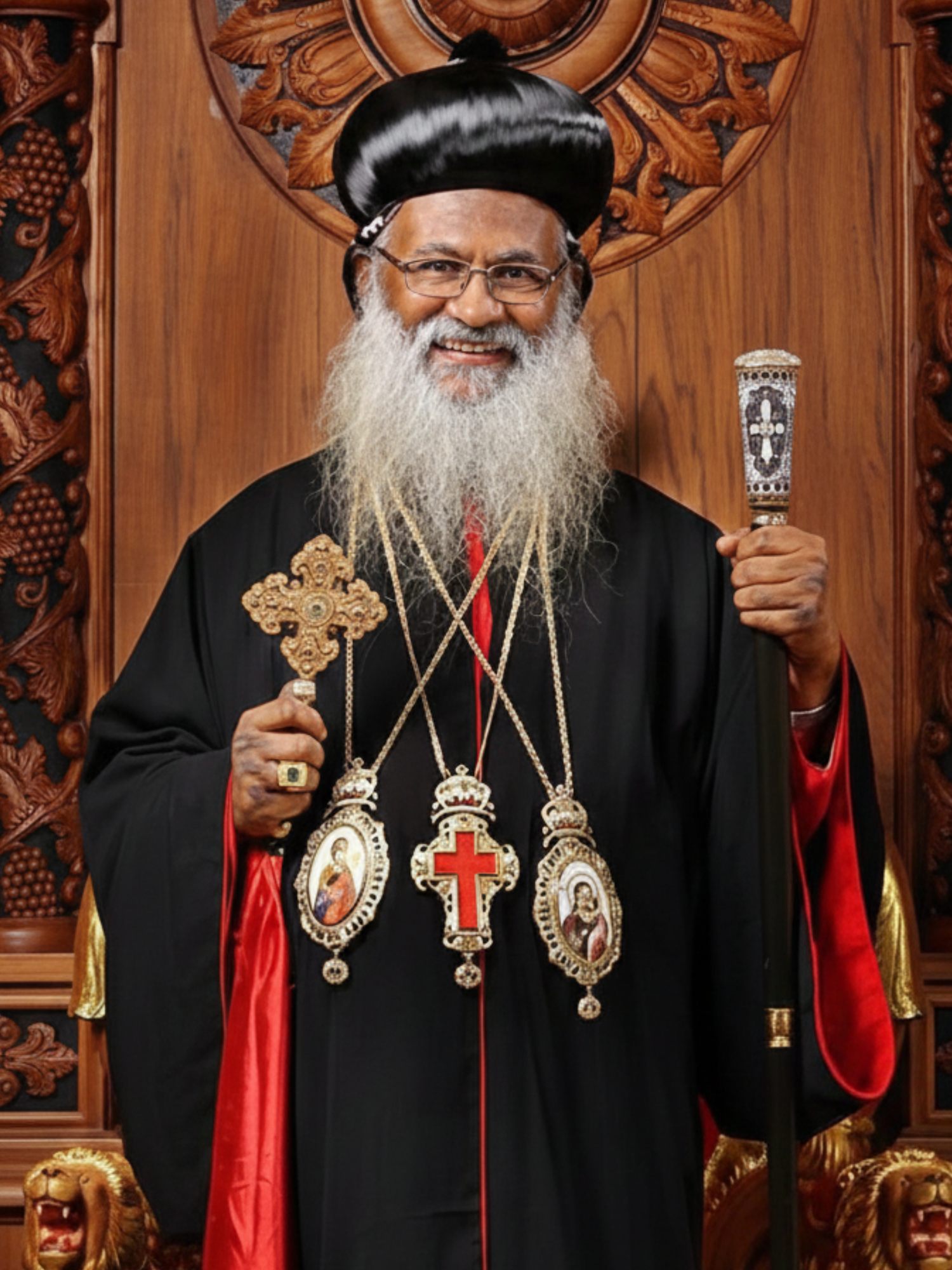
Current Occupant of the Throne
H.H. Baselios Marthoma Mathews III
9th Catholicos of the East & Malankara Metropolitan
Enthroned 15 October 2021
Read His Holiness's Biography